Face · 5 min read
The Science Behind Facial Harmony Scores
“Facial harmony” gets thrown around a lot without anyone defining it. It sounds scientific, but in most consumer apps it's a black box that spits out a number designed to make you feel good. We try to do something more honest: treat it as a composite of geometric features, each tied to a rubric, each carrying a known weight in the final score.
What “harmony” actually measures
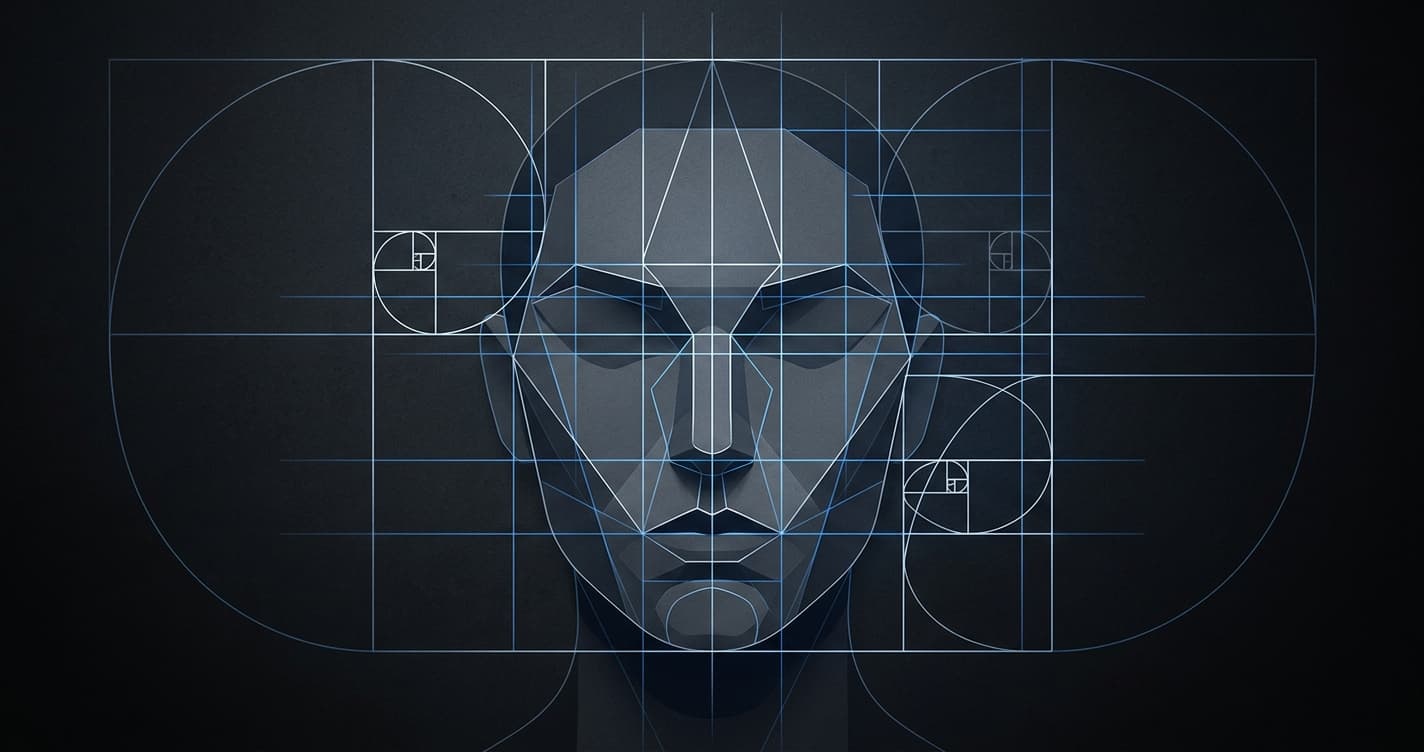
In our model, harmony is how well the major spatial relationships of a face agree with each other: the rule of thirds (forehead, midface, lower face), the rule of fifths (horizontal eye spacing), how defined the jaw is relative to the cheekbone, how far the chin projects relative to the lip line, and how symmetrical the face is left-to-right. None of these is enough by itself. A perfectly symmetrical face with a recessed chin can still read as off, and a fairly asymmetric face with great overall proportion often comes across as charismatic rather than wrong.
Why we use a real bell curve
A score only does work if it can tell people apart. Most apps cram everyone into the 7–9 range, which means the score is basically decorative. Objektiv anchors 5.0 to the population average, and about 68% of users sit between 4 and 6. A 7 is genuinely above average. An 8 is rare. A 9 has to be defended by the model with explicit reasoning, and our server tosses it out if the rationale doesn't hold up. We're not trying to be harsh — we're trying to make the number worth reading.
Anti-inflation rules
Internet-trained vision models lean hard toward flattery. Left to their own devices, they'll cheerfully call every face an eight. Our system prompt fights this on the way in: the model has to spend its words on what's improvable, not on what's already working, and it can't hand out high scores without naming the specific geometric feature responsible. We also validate on the way out — anything above 8 without a documented reason gets rejected and re-rolled before it reaches your dashboard.
What the score is not
A harmony score is not an attractiveness score, not a measure of your worth, and not something fixed about you. It measures geometric agreement at one moment, in one photo, under specific lighting. Hair, beard, posture, expression, and angle all shift the number. Two analyses a week apart can give the same person different scores, and that's the point — it forces you to think about what you actually control rather than treating the number as a tattoo. Two related reads, What Is a Color Season and Why Does It Matter? and How AI Can Help You Find Your Best Hairstyle, go deeper on two of the variables that move the score most.
From score to action
The score on its own is the boring part. What matters is the breakdown — which sub-component is pulling the composite down, and what would actually move it. A 5.4 with a weak jaw and strong thirds is a different person with a different action plan from a 5.4 with a strong jaw and a long lower third. The dashboard surfaces both, orders the recommendations by time-to-impact and cost, and labels which interventions are reversible (haircut, beard) versus non-reversible (cosmetic procedures, which we generally talk you out of).
Read more
See how the platform fits together on the About page, or check the pricing page for tier details.
Last updated: April 25, 2026